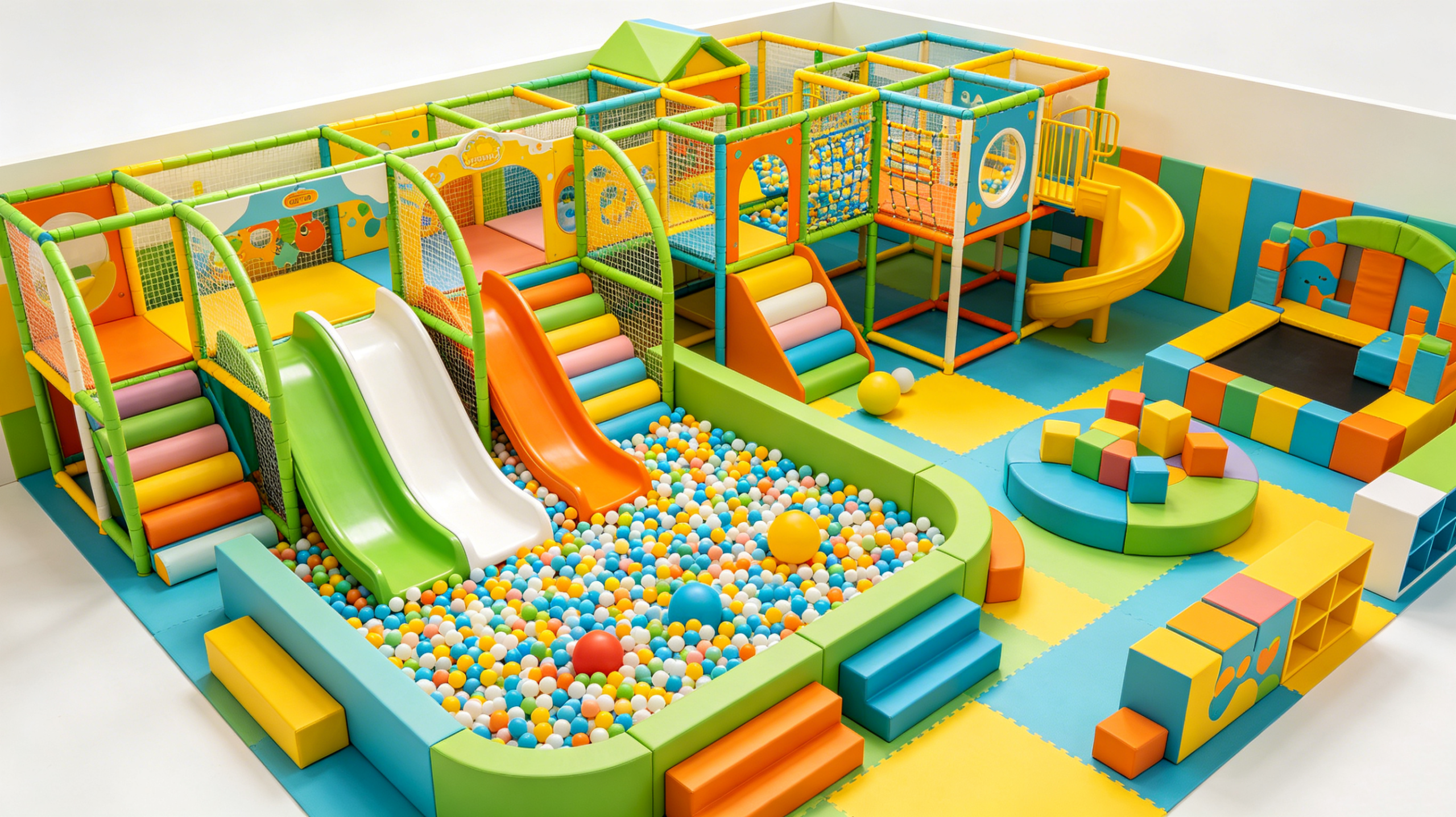
A 30-square-meter play corner in a daycare and a 500-square-meter themed play structure in a family entertainment center sit at opposite ends of a pricing spectrum that can run from roughly 8,000towellover200,000 for equipment alone. The gap is not random. It is the product of a handful of engineering and commercial decisions that compound across materials, labor hours, regulatory requirements, and logistics. Understanding which factors move the price — and by how much — is the difference between an informed budget and a nasty surprise.
The commercial indoor playground equipment cost an operator ultimately pays is shaped far more by these underlying variables than by any sticker price in a catalog. What follows is a breakdown of the factors that genuinely drive the numbers.
1. Physical Footprint: The Square-Meter Baseline
Floor area is the single most powerful cost multiplier in indoor playground pricing. A 50-square-meter installation might consume two weeks of fabrication labor and a single shipping container. A 300-square-meter project can require eight to twelve weeks of factory labor, multiple shipping containers, and a multi-day installation crew. The relationship is not strictly linear — there are economies of scale — but it is close.
As a rough guide drawn from industry data, equipment costs for a modest soft-play setup designed for toddlers typically fall in the range of 180to350 per square meter, while larger, multi-level structures with climbing walls, net bridges, and spiral slides can reach 450to800 per square meter. Roof height also matters: a play structure reaching 4 meters demands taller steel columns, longer connecting tubes, and additional cross-bracing compared to a 2.5-meter design for the same floor footprint. Each additional vertical meter adds structural steel, fabrication time, and installation complexity.
This is why any credible quote request begins with floor plans and ceiling height — not because manufacturers are curious, but because the math starts there.
2. Equipment Complexity and Play Types
Not all square meters cost the same. A flat soft-play area with foam shapes, small slides, and a ball pit is among the least expensive configurations because the components are standardized and the assembly is straightforward. Add a multi-level climbing net structure, and the per-square-meter cost rises sharply — netting requires tension cables, steel support frames engineered for dynamic loads, and fire-rated materials.
Interactive electronic elements represent another step up. Touch-sensitive play panels, projection-mapped floor games, and RFID wristband scoring systems introduce embedded electronics, software licensing, and maintenance contracts. A single interactive projection game zone can add 8,000to20,000 to the equipment budget. Trampoline zones — which demand specialized spring beds, frame padding, and perimeter netting certified to absorb repeated impact — likewise push the per-square-meter cost well above the soft-play average.
The age group being served further shapes the commercial indoor playground equipment cost. Equipment designed exclusively for toddlers (ages 1–4) can use shorter fall heights, smaller components, and simpler geometry, keeping structural and surfacing costs lower. Equipment intended for school-age children (5–12) must accommodate higher dynamic loads, taller climbing sections, and more complex safety enveloping — all of which require heavier steel sections and more rigorous engineering review.
3. Materials and Construction: Steel, Foam, and What Gets Tested
The bill of materials for an indoor play structure breaks into three main categories: the structural frame, the playing surfaces, and the safety surfacing.
Structural frames are overwhelmingly welded mild steel, typically powder-coated for corrosion resistance. The gauge and wall thickness of the steel tube directly affect cost — thicker schedules mean higher raw material cost, heavier shipping weight, and more welding time. A structure engineered for a 5,000-cycle-per-day amusement venue uses different steel specifications than one designed for a 50-child preschool, and the price reflects it.
On the playing surfaces, closed-cell EVA (ethylene-vinyl acetate) foam dominates because of its resilience, light weight, and ability to be cut into complex three-dimensional shapes. Higher-density EVA foams (60–80 kg/m³) resist compression and extend service life but cost more per cubic meter than lower-density alternatives. PVC-coated fabric covers on foam components — which determine color, texture, and cleanability — range from standard grades to antimicrobial or flame-rated formulations, with the latter carrying a cost premium.
Fiberglass slides, spiral tubes, and themed molded elements are manufactured from gel-coated fiberglass reinforced plastic (FRP). Each curved slide profile requires a dedicated mold; a seven-meter spiral tube slide may involve a mold cost that adds thousands to the project. This is one reason why custom-themed elements — rocket ships, tree houses, castle turrets — consistently cost more than generic geometric shapes: the mold amortization is divided across a smaller number of units.
3. Safety Certification and the Compliance Premium
A structure that meets ASTM F1918, EN 1176, or equivalent standards costs more to produce than one that does not — and the difference flows through the total commercial indoor playground equipment cost in both visible and invisible ways.
Visible costs include the additional material required to meet safety enveloping requirements. ASTM F1918 and EN 1176 define minimum clearance zones around moving elements, minimum guardrail heights, maximum head-entrapment gaps, and limiting angles for climbing surfaces. Designing to these standards often means adding more steel to create guardrails at specific heights, enlarging platform areas to provide safe landing zones, and replacing rigid connectors with articulated joints that permit the safety inspections required by the standard.
The invisible cost is engineering documentation. A manufacturer producing ASTM-compliant equipment must maintain design files demonstrating compliance with each applicable clause, perform load-testing on representative assemblies, and in some cases submit to third-party inspection by an accredited testing laboratory. These costs are embedded in the equipment price — equipment from a compliance-oriented manufacturer will typically carry a 15% to 25% premium over functionally similar but uncertified alternatives.
For operators in the United States, CPSC Publication 325 — the Public Playground Safety Handbook — provides a parallel compliance reference alongside ASTM F1918. Operators and their insurers increasingly expect documented compliance, and the cost of retrofitting non-compliant equipment after installation routinely exceeds the upfront compliance premium.
4. Custom Design vs. Modular Catalogs
The design approach — fully custom versus modular catalog selection — is among the most consequential commercial decisions affecting equipment pricing.
Modular systems use pre-engineered components (panels, tubes, connectors, slides) from a factory product library. The components have known dimensions, known structural capacities, and pre-calculated installation times. Because the engineering has already been amortized across many projects, the unit cost is lower. A mid-sized modular play structure of 100 square meters might cost 25,000to50,000 in equipment, depending on height and material grade.
Custom-designed structures start from the floor plan and site conditions. An architect or industrial designer creates a unique layout; structural engineers derive member sizes from first principles; the fabrication shop cuts and welds components that have never been made before. Each curved tube, each themed facade panel, and each irregular platform is a one-off. The result is a far higher design-engineering cost, a longer fabrication cycle, and a structure that cannot be partially re-sold or repurposed. Custom equipment for the same 100-square-meter floor area can range from 60,000to120,000 or more — roughly double the modular equivalent.
That said, the premium is not always wasted. A branded, themed, one-of-a-kind play environment differentiates a family entertainment center in a competitive market, potentially supporting higher admission pricing. The commercial indoor playground equipment cost premium for custom design must be evaluated against the revenue premium the uniqueness can command — a calculation that varies sharply by local market conditions.
5. Theming, Decoration, and Visual Finish
Theming is often listed as a separate line item, but it is fundamentally an extension of customization—covering every visual and atmospheric element beyond structural safety. This includes fiberglass facade panels shaped like tree bark, airbrushed murals on climbing walls, LED lighting embedded in platform edges, and custom fabric canopies over activity zones.
A basic color scheme — three or four vinyl colors on standard geometric panels — adds relatively little to the total. A fully themed environment can add 30% to 60% to the equipment line. The reason is labor: sculpting, painting, and finishing a fiberglass “rock wall” or “castle keep” is a craftsman’s task, not a factory line operation. Themed elements also introduce longer lead times and additional mold investments, both of which appear in the quote.
6. Shipping, Installation, and the Hidden Geographic Factor
For operators importing equipment — a common arrangement given the concentration of manufacturing capacity in East and Southeast Asia — ocean freight, port handling, inland trucking, and customs duties can add 10% to 25% to the ex-factory equipment price. A full 40-foot container to North America or Europe may run 3,000to8,000 in freight costs depending on fuel surcharges, routing, and seasonality.
Installation is a separate and often underestimated cost. Factory-trained installation teams charge daily rates plus travel and accommodation. A 100-square-meter modular structure might require a three-person crew for four to five days; a 300-square-meter custom structure could require a five-person crew for two weeks. At industry rates of roughly 300to600 per installer per day, installation alone can add 6,000to25,000 to the project. Operators who attempt self-installation to save this cost often discover that misaligned panels, incorrectly torqued connections, or overlooked safety clearances produce an installation that fails inspection — triggering a costlier re-work.
7. Market Context: Why the Factors Are Increasingly Important
The global indoor playground market was valued at approximately 6.1billionin2024andisprojectedtoreach11.5 billion by 2033, growing at a CAGR of 8.2%, according to Growth Market Reports. The broader children’s entertainment centers market — which includes indoor playgrounds as a key segment — was valued at roughly
18.6billionin2024,accordingtoDataHorizzonResearch,andisforecasttoreach31.4 billion by 2033 at a CAGR of 5.9%.
These growth trajectories mean more operators entering the market, more supplier options, and wider price dispersion. The same square footage can attract quotes that differ by a factor of two or more — not because anyone is being dishonest, but because the underlying design, material, and certification decisions are genuinely different. The operator who understands which factors drive cost can negotiate a quote that aligns with their business model rather than accepting a price that reflects someone else’s assumptions about their market.
Conclusion: Pricing Factors Are a Mirror of Design Choices
Every factor that shifts the commercial indoor playground equipment cost is ultimately a design decision the operator controls or influences. Square footage, equipment complexity, material grade, certification standard, customization level, theming intensity, and logistics geography — these are not forces beyond control. They are levers. The operator who defines the target age group, the intended throughput, the brand positioning, and the required regulatory standard before requesting quotes will receive prices that converge on a defensible range. The operator who requests “an indoor playground quote” without specifying these parameters will receive numbers that span an unusably wide range — because the suppliers, lacking guidance, will fill in the assumptions themselves, and no two will fill them in the same way.