

Trampoline Park Market Size and Growth Forecast 2026-2033
The global trampoline park market size reached about $0.561 billion in 2025. Industry analysts expect a value near $1.088 billion by 2033. This forecast shows a compound annual growth rate (CAGR) of 8.63% from 2026 to 2033, though estimates vary by source. One widely cited study puts the trampoline park cagr at 13.90% over a similar period.
Two forces drive this growth. Families now spend more on shared experiences, and consumers treat active play as exercise. Operating costs and safety regulation remain the main restraints. Regional size, park types, and the competitive landscape all shape outcomes. Liben Play, a Trampoline supplier, offers one example of how equipment partners support operators.
Key Takeaways
- The trampoline park market will grow quickly, reaching about $3.49 billion by 2033.
- Families want to have fun together and stay active, and this is helping parks grow.
- Opening a park costs a lot of money, so owners need to plan for big expenses.
- Safety rules are strict, so operators should buy equipment that is certified.
- New areas such as Asia-Pacific give the best chances for new parks.
Global Trampoline Park Market Size and Forecast

Market Size (2026 Baseline)
The trampoline park market is worth about $0.561 billion in 2025. This starting point shows a business that has grown from a fad into a steady part of the leisure industry. Another estimate puts the market at $950.1 million in 2023. That number comes from a trampoline market research report that tracks the same segment using a different method. Both numbers describe the same basic business, and the gap between them shows differences in scope and data collection, not a contradiction.
The bigger picture matters here. Trampoline parks run inside the family and indoor entertainment center market. Market.us values that market at $29.4 billion in 2024 and expects $87.3 billion by 2034 at a compound annual growth rate of 11.5%. Future Market Insights shows a similar path, going from $34.4 billion in 2025 to $93.5 billion by 2035 at 10.5%. Allied Market Research puts the family and indoor entertainment centers market at $108.4 billion by 2033 at 12.1%. These projections place the trampoline segment as one part of a much larger leisure category.
The indoor amusement center market shows similar momentum. Market.us reports $52.4 billion in 2024 growing to $137.2 billion by 2034 at 10.1%. Spherical Insights tracks $22.17 billion in 2021 rising to $42.64 billion by 2030 at 9.79%. Market Research Future cites $64.94 billion in 2024 reaching $134.19 billion by 2035 at 6.82%. This kind of variation across sources is normal for a young category.
2026–2033 Forecast and CAGR
The 2026–2033 forecast points to about $1.088 billion by 2033. That path implies an 8.63% cagr, based on the $0.561 billion starting point in 2025. An upper-range scenario projects a 16.2% cagr and a value of $6.17 billion by 2035. The gap between these scenarios shows uncertainty about how fast parks get built, how much consumers spend, and how quickly regions adopt them.
CAGR, or compound annual growth rate, measures the steady yearly rate that moves a starting value to an ending value over a set period. A 13.9% cagr means the market grows by that percentage each year on a compounded basis. Readers should treat any single cagr as a planning tool, not a promise.
The market outlook for trampoline parks depends on several factors. Spending on experiences supports demand. Capital costs limit supply. Safety standards shape operator quality. The market size forecast above assumes steady progress on all three fronts. Any shift in one area will change the actual result. The trampoline park market therefore offers meaningful growth potential, with a realistic range rather than a single number. Analysts tracking market share across regions will watch how quickly emerging markets add capacity. That capacity will decide whether the upper or lower scenario proves closer to reality.
Trampoline Park Market Size by Region
Regional data splits the global picture into mature and emerging zones. North America and Europe have older parks and steady demand. Asia-Pacific and the rest of the world add parks at a faster pace. Each region has its own costs, safety rules, and consumer habits. A trampoline market research report covering each region shows this split clearly.
North America Trampoline Market Research Report
The north america trampoline market research report puts the US market at $750.4 million in 2024. That figure is the base for the north america trampoline market sizing and forecast. The region acts as a mature market. Park counts are high, and operators compete on experience rather than novelty. The North America large trampoline market is projected to grow at a compound annual growth rate of 4.4% over 2026 to 2033. For context, the global large trampoline market is forecast to grow at 6.3% over the same period, reaching USD 4.72 billion by 2033. Readers should not mix up the global figure with the regional estimate.
The key highlights of the north america trampoline market research report focus on replacement demand and park upgrades. Operators replace foam pits, nets, and jumping surfaces. Replacement cycles matter more than new builds here. A park that opened a decade ago now needs new springs, padding, and netting. This refresh work supports steady equipment sales. A second north america trampoline market research report tracks the same pattern across Canada and Mexico.
Europe Trampoline Market
The europe trampoline market shows steady indoor entertainment demand. Families already treat indoor play as normal leisure. Safety maturity shapes the europe trampoline market more than raw park counts. The europe trampoline market sizing and forecast reflects this steady base. Operators in the europe trampoline market invest in compliance and refurbishment. Landlords in dense cities favor indoor sites, because weather does not stop operations and footfall stays predictable across seasons. A europe trampoline market research report usually tracks park openings, equipment replacement, and visitor spending.
European operators work within a detailed rule set. The european regulatory framework covers playground equipment, surfacing, and park operations. Key standards include:
- EN 1176-1: general safety requirements and test methods for public playground equipment.
- EN 1176-7: guidance on installation, inspection, maintenance, and operation.
- EN 1177: impact-attenuating surfacing matched to critical fall height.
- EN 13219: structural requirements for commercial trampolines.
EN ISO 23659 sets safety requirements for trampoline park design, construction, inspection, and maintenance. It is not harmonized under the General Product Safety Regulation, yet manufacturers and installers should still use it to determine compliance.
Asia-Pacific and the rest of the world are emerging regions with fast growth. Crowded cities favor small indoor parks. Rising household spending on family leisure supports new openings. Local partners handle installation and service. Equipment suppliers that offer customization and compact designs fit these markets well. These regions add supply quickly, and their path will shape the global size of the category.
Market Segmentation by Park Type
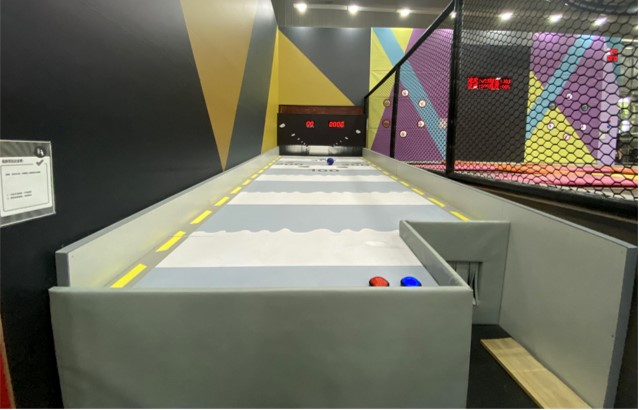
Indoor vs. Outdoor Parks
Indoor and outdoor parks work in different kinds of spaces. Bad weather does not stop money from coming in, and heating and cooling keep bookings steady all year. Building costs run higher per square meter, because airflow, padding, and lighting all add to the price.
Outdoor parks use bigger spaces and cost less to build per square meter. They work well in warm climates and at spots with parking and open room. Rain and heat cut down the days they can open, so income moves up and down more. Each setup fits its own place best; neither one is better than the other.
Small designs drive much of the growth in indoor park equipment. A frame that folds, a padded safety skirt, and a strong polypropylene mat show how makers shrink a jumping surface without losing safety. One small model measures 36.5″ x 36.5″ x 8.75″, folds flat to store, and holds up to 250 lbs.
Family Entertainment Centers vs. Standalone Parks
Family entertainment centers mix trampolines with arcade games, food, and party rooms. Shared visitors make visits longer and raise spending per guest. This way of running things spreads staff and marketing across several attractions. Standalone trampoline parks put their money into one activity. They build a clear brand and simpler staffing, but they rely on that single draw.
Sorting the market by use helps developers pick between these models. Commercial indoor parks inside malls and activity centers gain from visitors already there. Liben Play’s Trampoline solutions fit these small spaces. Owners can ask for foam pits, climbing walls, dodgeball arenas, and basketball setups, with a 170 kg/sqm load capacity for ages 3 and up. Commercial trampoline parks that tailor layouts this way match local demand and site limits.
Key Growth Drivers
Experiential Entertainment Demand
People now put more of their money toward shared experiences. Over the last ten years, the part of spending that goes to leisure rose from 9.5% to almost 13%, after adjusting for inflation. Spending on recreation goods went up 165% in that same time. Families with kids are choosing outings more often than buying things, and when they share those outings on social media, it brings repeat visits and new customers.
This change helps indoor trampoline parks in a direct way. Global family entertainment center revenues should reach about $35 billion by 2027, growing at a 4.8% CAGR from 2023 to 2027. The larger family and indoor entertainment center market goes from $26.9 billion in 2026 to $48.2 billion by 2033 at 8.7% CAGR. Mall owners also give anchor space to entertainment venues to keep foot traffic up. These forces are among the strongest growth drivers for the category.
Health and Fitness Trends
Active play now counts as exercise for many consumers. Trampoline use works almost all muscle groups, including glutes, legs, upper body, and core. The elastic surface softens landings, so joints take less impact than running. Bouncing also sets off a dopamine and endorphin response, which makes the workout feel rewarding and easier to keep up.
This fitness angle brings in a wider audience for trampoline parks than just children. Adults book sessions to get cardio and strength work in one visit. Schools and corporate groups add commercial revenue through events. Indoor park growth therefore rests on two pillars: families looking for experiences and health-minded adults. Together they support steady growth across mature and emerging regions.
Challenges and Restraints
Operational and Maintenance Costs
It takes a lot of money to start a park, and that stops many new owners. A competitive 25,000–35,000 sq ft park usually needs $1.5 million to over $3 million. Small boutique parks can open for under $750,000, but big franchises with many attractions may cost more than $5 million. Equipment by itself runs $450,000 to $900,000 or more. Building out the facility adds $300,000 to $700,000. Rent and a three-month deposit cost $75,000 to $150,000. The table below shows typical startup costs.
| Expense Category | Low End | High End |
|---|---|---|
| Trampoline & Adventure Equipment | $450,000 | $900,000+ |
| Facility Build-Out | $300,000 | $700,000 |
| Rent & Deposit (3 Months) | $75,000 | $150,000 |
| Technology (POS, Website) | $30,000 | $60,000 |
| Marketing & Pre-Opening | $40,000 | $100,000 |
| Insurance & Legal | $20,000 | $50,000 |
| Furniture & Fixtures | $50,000 | $120,000 |
| Total Estimated Startup | $965,000 | $2,080,000+ |

After opening day, regular costs keep adding pressure. Utilities cost $2,500–$7,000 each month. Maintenance and repairs run $4,000–$8,000 per month. Staff, marketing, and supplies add even more. Owners also pay liability insurance of $5,000–$10,000 a year and need a cash buffer of $200,000–$300,000. One surprise equipment breakdown can wipe out a whole month of profit. These numbers show why the europe trampoline market favors established operators who can get capital. New entrants in the europe trampoline market must plan for startup and operating costs before they sign a lease.
Safety and Regulatory Standards
Safety rules affect every trampoline parks project. ASTM standards control equipment design and testing in the United States. EN1176 covers public playground equipment in Europe. GS and TUV marks show tested quality for many buyers. Following the rules raises design and paperwork costs. It also separates serious suppliers from casual ones. Operators who skip certification face higher insurance premiums and legal risk.
Liben Play meets these standards as an example. The company holds ISO9001 and GS certificates and follows ASTM and EN1176 requirements. Its trampoline frames carry a 170 kg/sqm load rating. These certifications help growth in the europe trampoline market, where the european regulatory framework requires documented compliance. Buyers there see certification as a basic need, not a bonus.
Competitive Landscape and Key Players
Leading Companies and Strategies
The competitive landscape includes both park operators and equipment suppliers. Operators compete on location, brand, and guest experience. Suppliers compete on design, safety compliance, and delivery capacity. A trampoline market research report follows both groups. A market share analysis shows a fragmented field with no single dominant player.
Altitude Trampoline Park shows the operator side. Robert Morris is Vice President of Development at Indoor Active Brands. He describes a cluster expansion strategy. The company builds several parks within driving distance in high-demand markets like Florida, Chicago, and California. This density strengthens brand recognition. It also lets franchisees share marketing, staffing, and supply chains. Altitude is nearing 100 locations worldwide and opened six new parks in 2025. The major north america trampoline market companies follow similar paths. The north america trampoline market research report tracks this franchising trend closely.
Liben Play’s Trampoline Positioning
Liben Play (Liben Group) supplies trampoline equipment to global distributors, developers, and operators. The company started in 2011 in Qiaoxia, Wenzhou. This town supplies a large share of the world’s playground equipment. It holds ISO9001 and GS certificates, more than 100 patents, and membership in IPEMA and ITAP. Clients include Vanke, Fantawild, and Wanda Plaza.
Its differentiators rest on customization, compact-space design, and international safety compliance:
- More than 35,000 global projects completed
- A 60,000-plus square meter factory
- ISO 9001, GS, and combined EN and ASTM certification
The europe trampoline market rewards this compliance focus. The european buyer base treats certification as a baseline. A europe trampoline market research report often cites supplier certification as a selection factor. Liben Play also guides clients from business planning through design, manufacturing, logistics, installation, and operations training. That support helps operators protect market share in a crowded field. The europe trampoline market continues to value partners who combine customization with documented safety.
The trampoline park market hit about $0.561 billion in 2025. Analysts expect around $1.088 billion by 2033, with a cagr of 8.63% from 2026 to 2033. Fun experiences and fitness trends push this growth. Operating costs and safety rules challenge every operator.
Emerging regions offer the clearest chance to grow. Different park types help developers match what local people want. Custom equipment from suppliers like Liben Play supports small, safe builds. The future of north america trampoline market depends on upgrades and replacement demand. The future of europe trampoline market rests on following rules and steady family spending. The europe trampoline market rewards certified suppliers. The europe trampoline market also favors experienced operators. The european buyer treats safety paperwork as a basic need. The europe trampoline market will keep setting quality standards.
FAQ
How fast will the trampoline park market grow through 2033?
Experts expect the market to grow by 8.63% each year from 2026 to 2033. The base case puts the market near $1.088 billion by 2033. A higher scenario reaches $6.17 billion by 2035. Growth depends on new park construction, consumer spending, and safety compliance.
Which regions lead in park numbers and equipment demand?
North America has a mature base, with the US market at $750.4 million in 2024. Europe shows steady family leisure demand and strict safety rules. Asia-Pacific adds capacity quickly. Each region shapes the europe trampoline market in its own way, and suppliers watch these shifts closely.
What safety standards should operators verify before buying equipment?
Buyers should confirm ASTM and EN1176 compliance. The GS mark from TUV Germany shows tested quality. Liben Play holds ISO9001 and GS certificates and meets both standards. Certification lowers insurance risk and supports the europe trampoline market, where documented compliance is a basic expectation.
What size park fits a shopping mall or small venue?
Compact indoor layouts work well for malls and activity centers. Liben Play designs trampoline parks for small spaces, with room for 15 to 25 people and a 170 kg/sqm load rating. Custom features include foam pits, climbing walls, and dodgeball arenas for ages 3 and up.
How does equipment choice affect long-term operating costs?
Durable materials cut replacement spending. Galvanized steel frames and quality padding last longer. Certified equipment also lowers liability risk. Operators in the europe trampoline market prefer suppliers with proven compliance records, because steady growth depends on safe, well-maintained facilities.


