

Selecting the Right Trampoline Park Equipment Manufacturer – A Complete Checklist
Every trampoline park starts with one key decision: which manufacturer should you trust? That choice decides if you open on time with an attraction guests love—or face delays, downtime, and costly do-overs.
Think of this post as your full trampoline park equipment buying guide. It gives you a step-by-step checklist made for owners and operators. You can use it as you plan.
Price alone should not drive your choice. Venue model, site conditions, safety certificates and approvals, and long-term support matter far more. Strong safety standards protect both your guests and your reputation. Keep this checklist close when choosing a manufacturer. It turns a hard choice into a practical action plan.
Key Takeaways
- Decide on your venue model and equipment needs before talking to manufacturers.
- Measure your site and check the floor load to make sure it is safe and fits well.
- Check the safety certificates and approvals for the exact equipment model.
- Check the design, engineering, and customization choices for a one-of-a-kind park.
- Compare their past projects, support, and warranty to avoid expensive downtime.
Define Your Venue Model and Trampoline Park Equipment Needs
Match Equipment to Your Park Format
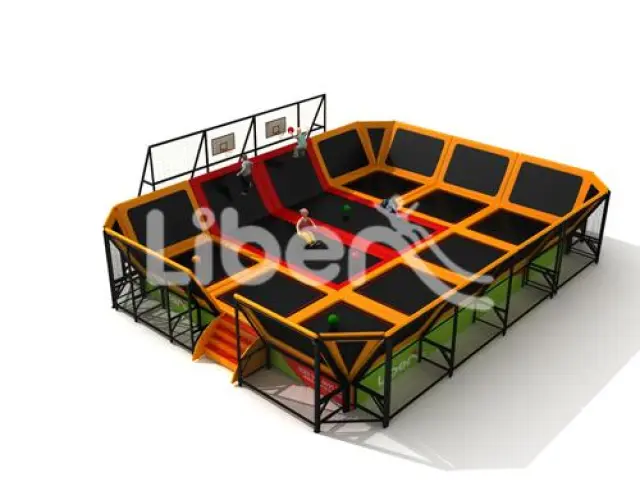
The kind of park you run shapes every equipment choice you make. A freestyle park that stands alone focuses on big-air trampolines, foam pits, and advanced dodgeball courts for teens and young adults. A family entertainment center needs a wider mix. You should add toddler zones, interactive play areas, and party rooms to bring in groups of all ages. A small indoor park under 200 square meters needs space-saving designs more than anything else.
Liben Play‘s trampoline solutions for small spaces show how a smart layout fixes a limited footprint. These designs fit free jumping zones, foam pit zones, climbing walls, and gymnastic trampolines with soft walls into tight areas. You can also add basketball setups and dodgeball arenas. The table below shows suggested areas for common trampoline park equipment.
| Equipment Type | Recommended Area |
|---|---|
| Indoor Arena | 100-500square meters |
| Dodgeball Court | 30-80square meters per court |
| Outdoor Series | 15-50square meters |
Look over the full range of types of trampoline park equipment before you decide. A commercial trampoline park that serves families needs different attractions than one built for athletes.
Set Budget, Capacity, and ROI Targets
Budget planning must look past the upfront price. Long-term durability and maintenance costs decide your true return on investment. Cheap materials often lead to frequent repairs and downtime. That downtime costs you revenue and hurts guest trust.
Set your capacity target before you contact any supplier. Your age range also matters. Most trampoline park equipment serves children aged 3 to 12 and above. Indoor trampoline parks that welcome toddlers need their own soft play zones. Parks focused on teens need ninja courses and slam-dunk basketball setups.
Write down your capacity, age range, and budget ceiling. Share these targets with every manufacturer you approach. This step makes sure you compare proposals on equal terms. It also guards your safety standards and your profit goals from day one.
Check Your Site and Pick the Right Trampoline Park Equipment Supplier
Look at Space, Ceiling Height, and Floor Load
Before you ask for a trampoline park quotation, measure your space. Write down the room size, ceiling height, and floor load capacity. Your ceiling must be above the highest jump point plus the frame height. Your floor must handle both static and dynamic loads. Steel frames for an 800 square meter park weigh tens of thousands of kilograms. When 100 people jump together, they create a rhythmic force. Your floor slab must resist that force.
| Floor-Load Consideration | Required Value / Action | Relevance to Reinforcement |
|---|---|---|
| Static load | Steel frames weigh tens of thousands of kg | Building must carry dead load permanently |
| Dynamic load | 100 people jumping in unison | Floor must resist vibration and cracking |
| Minimum load capacity | 500 kg/m² | Basic trampoline zones without reinforcement |
| Advanced load capacity | 800–1,000 kg/m² | Multi-level Ninja structures or large slides |
| Concrete verification | Core Drill Test for concrete PSI | Confirms if existing floor can support equipment |
A Core Drill Test shows if your concrete meets the required PSI. If it fails, the building is not safe to use without added reinforcement.
Check Utility, Access, and Installation Limits
How people move through your site shapes your equipment layout. It also shapes your choice of the right trampoline park equipment supplier. Use loop pathways instead of dead ends. Keep main walkways wide enough for two large strollers to pass. Put high-capacity anchor attractions at the back. This pulls guests deep into the facility.
- Guest flow: use continuous loops, wide main paths, and anchor attractions at the perimeter
- Emergency routes: add rapid descent systems on high platforms, easy-to-reach rescue kits, and wide service roads for ambulances
- Equipment layout: check clearance zones and safety nets with your supplier during the layout phase
Ask every commercial trampoline park supplier if they offer site surveys or 3D layout planning. Liben Play does this through its custom design process. Check columns, beams, ducts, and lighting that lower clear height. Confirm emergency exits, front desk space, parent seating, party rooms, and storage. Write down electrical panel locations and service clearances. A strong trampoline park design handles these limits before installation starts.
Verify Safety Certificates and Approvals

Check Core Certifications and Testing Standards
Safety certificates and approvals show the difference between real manufacturers and assemblers. Look for a GS certificate from TUV Germany, ASTM and EN1176 safety standards, and ISO9001 on every quote. These prove product testing and factory quality control. Membership in IPEMA and ITAP adds credibility.
Liben Play holds all these credentials. Check each certificate against the equipment model you plan to buy. If the document does not list your model, ask for clarification.
A true manufacturer makes its own attractions. Resellers cannot show you a production line. Ask for a factory tour or video walkthrough. The right supplier welcomes your request.
The European market demands attention to the Toy Safety Directive. EN 71-14 applies to domestic trampolines. Commercial installations require CE marking, a Declaration of Conformity, and technical documentation. The General Product Safety Regulation covers structural performance. REACH restricts hazardous substances like PAHs, cadmium, and DEHP. A manufacturer should provide test reports for all of these.
Your safety certifications must apply to the exact model you buy. A certificate for one line does not cover another. Check serial numbers.
Confirm Insurance, Liability, and Local Code Alignment
The right safety equipment protects your guests, but proper approvals and certifications protect your business. Insurance underwriters file your trampoline park under a higher-risk category. Certification to ASTM F2970-17 signals that layout, padding, and fall zones meet a recognized benchmark. Annual public-liability coverage typically runs USD 5,000 to USD 40,000. Premiums sit at one to three percent of projected gross receipts or USD 0.30 to 0.60 per square foot. Inspection records matter. A gap of more than 90 days can trigger a declination or a 20 to 40 percent surcharge.
Commercial General Liability minimums start at $1,000,000 per occurrence and $2,000,000 aggregate. Experienced operators often carry $2,000,000 per occurrence and $4,000,000 aggregate. Leasing agreements commonly require a certificate of insurance with an each-occurrence limit of at least $1 million.
Local code alignment starts with building permits. Your city inspects structural modifications, electrical work, plumbing, fire sprinklers, and emergency lighting. The fire marshal can shut down your project. Fire inspections cover signage, sprinkler systems, extinguishers, alarms, and exits.
Fire codes require clearances for user safety. At least 18 inches of clearance must exist between equipment tops and sprinkler deflector heads. Some jurisdictions demand 24 inches. Materials must meet NFPA 701. Keep Material Safety Data Sheets and flammability test reports on site.
The Americans with Disabilities Act applies to commercial indoor playgrounds. You need accessible routes, transfer platforms, and entry ramps with a 1:12 slope ratio. City inspectors check these before issuing a Certificate of Occupancy.
Plumbing codes set fixture ratios based on occupancy. Arcade cabinets need dedicated 20-amp electrical lines from a licensed electrician.
Safety standards change over time. Annual safety inspections are mandatory in the European Union under EN ISO 23659:2022. U.S. law does not require them. Smart operators adopt them voluntarily to prove compliance and lower premiums.
When you evaluate a manufacturer, ask for a complete compliance package. It should include current safety certifications, test reports, and documentation aligned with your local code. The right partner navigates these requirements from quote to grand opening.
Evaluate Design, Engineering, and the Right Trampoline Manufacturer
A low price can hide a weak design team. How well the equipment is engineered decides how it fits your building and your daily operations. This section helps you judge design depth and customization ability.
Review In-House Design and Engineering Depth
In-house R&D shows real ownership. Manufacturers who make their own trampoline park equipment can show approvals and quality control. In-house production shortens lead times and boosts adaptability. Liben Play holds over 100 patents and helped draft Chinese national standards. That record shows genuine innovation. Ask every candidate for a factory profile, quality-control plan, material specifications, welding procedures, and sample inspection records. These documents show which steps happen in-house.
Integrated design + manufacturing + installation gives you one accountable partner. You coordinate theme development, spatial planning, packaging, installation, and operational preparation without middlemen. This workflow cuts down communication gaps. Strong engineers also catch site conflicts early. Structural engineers, inspectors, and operations staff should review the design before construction. Iterative 3D planning with CAD/BIM lets you inspect sightlines, emergency exits, and staffing digitally. Prepare scaled drawings, equipment cut-sheets, and accessibility narratives for the authority having jurisdiction. Complete documentation speeds up permits and insurance approvals. These steps prevent rework and downtime.
Assess Customization for Attractions and Theming
Your venue should not look like every other trampoline park. Customization creates distinct experiences that attract repeat visits. A capable trampoline park manufacturer offers foam pit zones, climbing walls, basketball slam-dunk setups, dodgeball arenas, and themed play areas. Liben Play provides free customized designs and turnkey solutions. Theming, logos, and color-matched padding turn a standard court into a branded destination.
Customization also covers the full design of a trampoline park. You choose dimensions and layout to fit your space and capacity. A layout might include a main court, reaction wall, dodgeball court, battle beam, foam pit, basketball slam dunk, wipe out, zipline, interactive jump, and rock climbing wall. These options represent the common types of trampoline park equipment. A professional trampoline manufacturer should offer expandable designs. A modular park lets you add obstacle courses or interactive games later. The right trampoline manufacturer supports you from concept through installation. That partnership protects your safety, uptime, and return on investment.
Compare Project Experience, Support, and Buying Guide Criteria
Review Completed Projects and Client References
A manufacturer’s past work shows you what to expect. Ask for a full project portfolio before you sign anything. Request installation photos, customer reviews, video walkthroughs, and business references. You need real case studies of active projects in your area. Detailed project descriptions help you judge quality. Feedback from past customers about product quality, communication, delivery times, and after-sales service shows how the supplier operates.
Contact two or three previous customers with similar project scope. Ask specific questions about on-time delivery, smooth installation, and support responsiveness. Ask about quality issues and whether they would work with the supplier again. This step lowers your operational risks.
Liben Play has served clients such as Vanke, Fantawild, Wanda Plaza, Lanbox, MBC, and Mascube across amusement parks, schools, and commercial spaces. Their completed trampoline park projects include Changchun LanBox, Shenyang LanBox, and a Congo School Playground. This project experience shows they can handle diverse venue types. An experienced manufacturer should show you at least three similar custom projects with client testimonials. Review their portfolio for themes like fairy-tale castles, sea octopus, and glow-in-the-dark interactive zones. Confirm logistics experience, including shipping time, customs documentation, insurance, and delivery to your region.
Compare Installation, After-Sales, Warranty, and Maintenance
Compare every supplier on the same criteria. Lead times, installation manuals, on-site support, staff training, warranty length, maintenance schedules, and marketing support all matter. Production time typically runs 20 to 30 days after you confirm the final layout and order details. Some suppliers offer 48-hour 2D layouts and free 3D previews. Ask who handles unloading, storage, local labor, tools, lifting, power, access, and waste removal.
Warranty and after-sales support vary widely. Trampolines, safety nets, PVC pipes, webbing, clamps, and nylon ropes often carry a one-year warranty. Springs, mats, and safety padding may include first-year replacement coverage. Electronic parts, gearboxes, and solenoid valves typically carry one year. Foam balls, plastic balls, and grip socks are consumables and not covered. Normal wear, misuse damage, unauthorized modifications, and environmental damage fall outside warranty terms. Choose suppliers who list exclusions in plain language.
Maintenance schedules should include daily inspections of mats, springs, pads, and nets. Weekly checks cover safety zone stability and impact performance. Professional inspections should occur once or twice a year. Prompt replacement of worn parts extends equipment life.
Build a like-for-like comparison table covering price, certifications, materials, lead time, warranty, and support. Use a proposal-input checklist with site dimensions, budget, capacity, theme, and timeline. This approach gathers consistent information from every trampoline park equipment supplier. Apply same-tier logic: same design, compare material; same material, compare engineering; same engineering, compare service; same service, then compare price. A reliable equipment supplier welcomes this scrutiny. This trampoline park equipment buying guide protects your investment in building and maintaining a trampoline park.
Your checklist comes down to six main choices: venue fit, site feasibility, safety certificates and approvals, design capability, proven project experience, and long-term support. The lowest price almost never means the lowest total cost. Downtime, repairs, and poor service eat away your profits quickly. Focus on safety, uptime, and support instead.
Before you sign, use your comparison table and proposal-input checklist. Then ask your shortlisted manufacturers for proposals. Set up reference calls with past clients. Visit finished trampoline park installations when you can. These last steps confirm your choice and protect your investment for years.
FAQ
What safety certificates should a trampoline park equipment manufacturer hold?
Look for a GS certificate from TUV Germany, plus ASTM and EN1176 standards. ISO9001 shows the factory checks its own quality. Being a member of IPEMA and ITAP makes a company more trustworthy. Make sure these certificates cover the exact model you want to buy.
What site measurements matter most when planning a trampoline park?
Measure the room size, ceiling height, floor load capacity, and utility access. Your floor has to hold both static and dynamic loads. Concrete tests tell you if your slab can safely support the equipment.
Can I customize a trampoline park for a small space?
Yes. Designs under 200 square meters can still fit free jumping zones, foam pits, climbing walls, and gymnastic trampolines. Liben Play gives you free custom designs that match your theme and capacity goals. A modular layout lets you add attractions later.
How do I compare suppliers beyond price?
Make a side-by-side table that covers price, certifications, materials, lead time, warranty, and support. Ask for a project portfolio and client references. Pay attention to long-term durability and maintenance costs. The lowest price seldom gives you the lowest total cost.
Where can I apply this trampoline park equipment buying guide?
Use this guide before you sign any proposal. Define your venue model, measure your site, check certificates, and compare support. Visit finished installations and call references. These steps confirm your choice and protect your investment for years.


