

How to Choose the Best Trampoline Indoor Playground for Your Family

Indoor trampoline parks are now a popular place for family fun. The global market reached $2.45 billion in 2024 and grows by 9.1% each year. But finding the best trampoline indoor playground for your family can feel overwhelming. You want a safe place. You need the right size. Your budget also matters. This trampoline buying guide helps you handle these challenges. You will learn how to pick a trampoline for your family by knowing important factors. These include size, weight capacity, safety features, and trampoline types. Good decision-making starts with understanding these selection criteria.
Key Takeaways
- Take measurements of your room and look at weight limits so you can choose the correct trampoline size.
- Pick an above-ground or in-ground trampoline based on your space and safety needs.
- Check for safety features such as padded walls, enclosures, and soft foam pits.
- Look for safety certifications such as GS, ASTM, and EN1176 to help keep your family safe.
- Think about springfree for the safest choice, or spring-based for a better price.
Size and Weight Capacity: Key to Choose a Trampoline for Your Family
When you shop for your family, two things matter most: the size of the unit and how much weight it can hold. Getting these wrong can turn a fun buy into a waste of money. Let’s look at what you need to check before you buy.
Measuring Your Indoor Space and Clearance
Start by measuring your room. You need to know the floor space and the ceiling height. Industry rules from ASTM F2970 and PAS 5000 require at least 17 ft (5.2 m) of clear space above the trampoline bed. For commercial parks, the suggested ceiling height is 20-25 ft (6-7.6 m). These safety clearances stop jumpers from hitting the ceiling during high bounces.
The trampoline footprint matters just as much. You need open space around the trampoline on all sides. A good rule is to leave adequate open area around the trampoline on all sides to ensure safe active play.
Liben Play offers compact designs that are perfect for smaller indoor spaces. For example, their small kids rectangular foam pit trampoline park measures 1160059003400 mm. That’s about 38 ft by 19 ft with a height of 11 ft. These dimensions work well for activity centers and shopping malls with limited floor plans. When you wonder what trampoline size for my yard or indoor space works best, a size guide from a trusted manufacturer helps you match your room to the right product.
Your space and layout determine what fits. Measure your room’s length, width, and ceiling height. Then compare those numbers to the trampoline’s dimensions. This step prevents costly mistakes.
Evaluating Weight Capacity for Multi-User Fun
Weight capacity is just as important as the footprint. Liben Play’s trampolines are designed to support multiple children playing together safely. You also need clear space around the trampoline for safe entry and exit.
The frame material determines how much weight a trampoline can hold. Liben Play uses galvanized steel frames. This material resists rust and corrosion. Thicker steel tubes improve stability and structural integrity. A galvanized steel frame can handle the bouncing forces from multiple users without flexing over years of use.
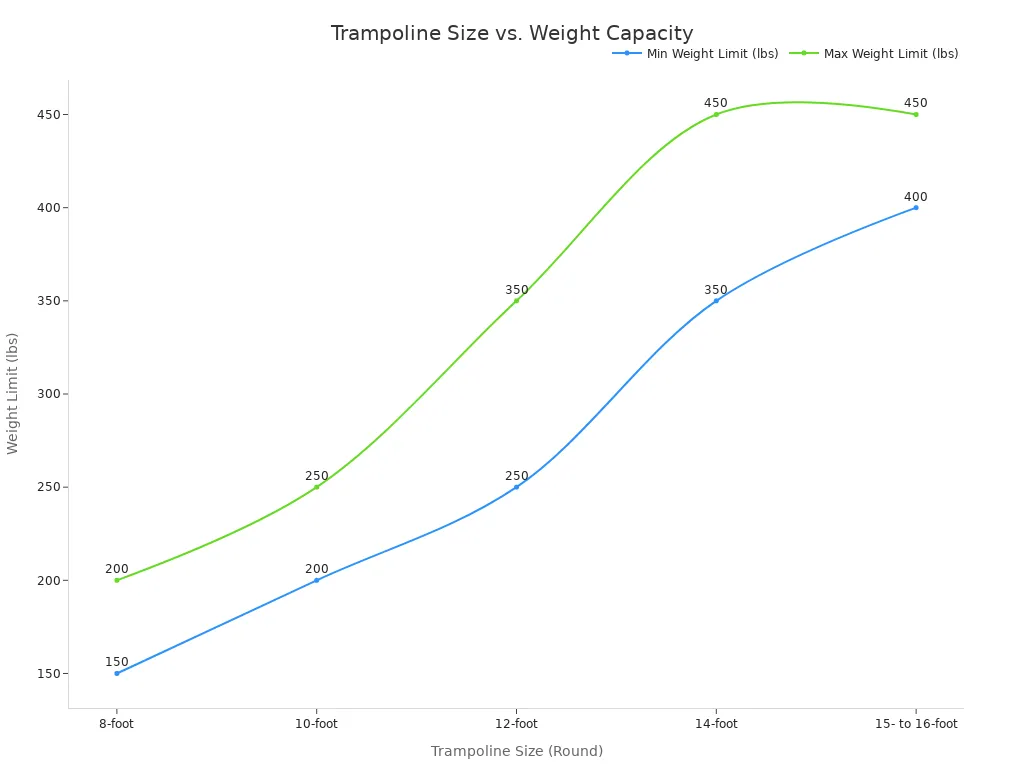
Here’s a quick reference for round trampoline sizes and their single-user weight limits:
| Trampoline Size (Round) | Single-User Weight Limit (lbs) | Primary Intended User |
|---|---|---|
| 8-foot | 150-200 | Single younger child |
| 10-foot | 200-250 | Single pre-teen |
| 12-foot | 250-350 | Standard household |
| 14-foot | 350-450 | Teens and larger groups |
| 15-to 16-foot | 400-450+ | Adults and groups |
Never go over the manufacturer’s stated weight limit. Doing so increases impact stress and can compromise structural integrity. If adults will use the trampoline, check the single jumper weight limit carefully. For example, a parent weighing over 175 lbs would exceed the limit of smaller models.
When you wonder which trampoline shape should i choose, remember that rectangular shapes often support more weight than round ones. Liben Play’s rectangular designs offer excellent support for group play. The right trampoline for your yard and family balances dimensions with weight capacity. Choose a model that lets your children grow with it. A trampoline that supports growing kids saves you from buying a new one later.
Types of Trampoline Parks for Your Family’s Needs
Choosing between different trampoline park setups for your family affects your fun and your space. The kind of trampoline indoor playground you pick determines how well it fits your home. Two main types stand out: above-ground and in-ground options. Each one works best for different situations. A size guide helps you match your room to the right product.
Above-Ground vs. In-Ground Options
Above-ground trampolines place the jumping surface about three feet off the ground. In-ground models sit at lawn level. The table below shows how they compare:
| Feature | In-Ground Trampoline | Above-Ground Trampoline |
|---|---|---|
| Access for young children | Walk-on, no steps needed | Requires step-up |
| Fall risk | Lower fall distance | Higher fall risk, needs quality enclosure |
| Bounce performance | Softer bounce (with vented mat) | Livelier, athletic bounce |
| Installation | Complex, needs contractor | DIY-friendly, 1-2 hours |
| Flexibility | Permanent, hard to move | Easy to move or store |
For safety, above-ground models include 360-degree nets and padded covers. But the raised height remains a fall hazard. The jumping surface sits 36-38 inches up. Combined with bounce, a fall can start from 6-10 feet. In-ground models reduce this fall distance. A jumper who leaves the mat lands on turf at ground level. Poor drainage can cause mud and rust problems though.
Your family can search for “indoor playground near me” to find ready solutions. When you compare indoor playgrounds vs. trampoline parks, note that trampoline parks need more vertical clearance. Indoor playgrounds often use less height space.
Professional Trampoline Parks by Liben Play
If you want a setup that works in tight indoor spaces, Liben Play offers professional trampoline parks. This brand holds relevant safety certifications. These standards prove the equipment meets strict safety rules. Liben Play designs compact, customizable trampoline indoor playground solutions for shopping malls and activity centers.
Their parks include a variety of attractions such as free jumping zones and foam pits. Every feature supports safe and developmentally enriching play. The foam pits use soft cubes for safe landings. Some designs add adventure features without high fall risks.
Customer examples show how Liben Play delivers results in various locations, turning spaces into popular destinations.
When you search for indoor playgrounds vs. trampoline parks online, remember that professional installations combine the best of both. Liben Play’s designs offer trampoline fun with playground safety features. That mix gives everyone a complete experience.
Safety Features That Make a Trampoline Indoor Playground Safe
When you choose a trampoline indoor playground for your family, safety is the most important thing. The right safety features turn a fun trip into a safe space. You want your kids to jump, laugh, and be protected. Let’s look at what matters.
Safety Pads, Enclosures, and Soft Walls
Padding is your first defense. High-density foam covers the springs and frame. This foam works like a shock absorber. It lowers the impact when a child lands near the edge. A layer of PVC or vinyl wraps the foam. This outer cover keeps water out and stops UV damage. Without it, foam soaks up moisture, breaks down, and loses its padding.
Soft walls are used in some designs for extra safety. These padded walls replace hard poles. Curved, padded poles give more space from the net. This design cuts down on injuries from hitting the poles. Safety enclosures made of nets also help. Nets push jumpers back to the center of the mat. They stop falls to the ground and collisions with poles.
Zipper closures on enclosures keep kids inside while they play. A secure zipper stops accidental exits. Using nets, pads, and adult supervision together keeps injury risk low. One jumper at a time in the center is a key rule. This simple habit stops double bouncing and energy transfer that can break bones.
For the safest trampoline for kids, look for these features. Thick foam padding, strong PVC covers, and secure enclosures make a safer choice for young children. Age-specific zones also help. Separate areas for toddlers and older kids prevent crashes between different sizes and energy levels.
Safety Certifications and Professional Installation
Certifications show that a trampoline meets strict safety rules. For example, ASTM F2970 covers design, make, installation, and care for trampoline parks. EN 71-14 sets European safety rules for playground equipment. These standards test UV resistance, weather durability, and material safety.
Look for ASTM F381 for home trampoline parts. It covers frame, bed, suspension, padding, and shock stopping. ASTM F2225 sets rules for enclosures, including net strength and impact resistance. EN 71-14 tests materials for UV and weather durability. REACH makes sure foam and fabrics have no toxins.
Professional installation is just as important as certification. DIY setups often cause mistakes. Wrong frame alignment, bad spring placement, or loose pads can hurt safety. Large parks over 500 sqm with complex features need expert help. Airbags, foam pits, ninja courses, and multi-level platforms have many parts. Professional on-site guidance makes sure the installation follows the design.
Professional installation manuals and support services help ensure proper setup. Right setup meets ASTM F2970 and ISO/DIS 23659 rules. These standards cover design, build, inspection, and care.
When you compare options, check for relevant safety certifications such as ASTM F2970 and EN 71-14. Ask about installation support. A certified park with professional setup gives your family a safe place to play. Safety features like padded walls, secure enclosures, and certified materials protect your kids. Your family deserves a space where fun and safety go together.
Spring vs. Springfree: Safety Features to Compare
How Springs Work and Their Maintenance Needs
Old-style trampolines use metal springs around the jumping mat. When you jump, these springs store energy. They release it to push you back up. The bounce feels good, but there are dangers. According to injury data, leg injuries make up 36 percent of all trampoline injuries. Arm injuries are 31.8 percent. Head injuries are 14.5 percent. Trunk injuries are 9.8 percent. Neck injuries are 7.9 percent.

These percentages show why safety is key when picking a trampoline for your family.
Springs need regular care too. Being outside makes them rust. Rust makes them weak and stiff. In commercial setups, springs last three to five years. Galvanized steel springs resist corrosion and offer durability. But springs can break early and no one notices until one snaps.
Regular inspection of springs, frames, and pads is recommended to ensure safety. Skipping these steps puts jumpers in danger.
Why Springfree Technology Gains Popularity
Springfree trampolines use flexible composite rods instead of metal springs. These rods sit below the jumping surface. The frame is hidden under the mat. This design removes two injury causes: falling off and hitting the frame. However, specific injury reduction data is not available in this guide.
Springfree can be considered one of the safest trampoline designs based on its features, but it comes at a premium price.
Some designs give a balanced choice. They use good galvanized steel springs with soft walls and foam pits. Soft walls replace hard poles. Foam pits soften falls. These features lower spring risks without the high cost. You get a steady bounce from steel springs plus extra safety. This mix works well for families who want fun and good value.
When you think about trampoline safety for your family, look at your budget and space. Springfree removes spring dangers completely. Other designs use proven spring tech with smart extras. Either way, look for relevant safety certifications such as ASTM F2970 and EN 71-14. Your family deserves gear that balances fun with safety.
Choosing the right trampoline indoor playground comes down to a few important steps. You now know how to check the size and weight capacity for your space. Liben Play offers a dependable choice with relevant safety certifications.
The best pick for your family balances fun, safety, and durability. Every family has its own needs. Start by measuring your space. Then look at certified options like Liben Play’s compact trampoline parks. You can build a safe, memorable play experience at home or in your facility. Your family deserves a place where everyone can jump, laugh, and stay safe.
FAQ
How can I tell if a trampoline park is safe for my kids?
Look for relevant safety certifications such as ASTM F2970 and EN 71-14. Check if the frame is made of galvanized steel. Reliable manufacturers meet these standards. Their equipment has soft walls and foam pits for extra protection.
What age is best for trampoline parks?
Most parks welcome children of various ages. Some designs create age-specific zones. Younger children get gentle bounce areas. Older kids enjoy athletic zones. This setup keeps everyone safe and having fun.
How do I keep indoor playgrounds clean and hygienic?
Ask about cleaning and sanitization rules. Good parks clean mats and foam pits every day. Some manufacturers provide maintenance guides. These help keep equipment fresh and safe for every jumper.
Can I customize a trampoline park for my space?
Yes, many manufacturers offer custom designs. Some providers offer free customized layouts. They adjust dimensions, features, and themes. This flexibility helps you match any indoor space perfectly.
What happens if my trampoline breaks over time?
Regular checks catch problems early. Inspect springs and pads regularly. For commercial setups, schedule yearly professional inspections. Many manufacturers offer ongoing support and replacement parts to keep your park running.


